Frequently Asked Questions
-
No two sessions are the same - because no two people are. I am deeply opposed to the one-size-fits-all approach to health that is so prevalent in modern medicine. You are unique, and your treatment will always reflect that.
Before your first session, I’ll send you an in-depth client form covering your physical and emotional history. To me, the two are inseparable - understanding both is essential to understanding you as a whole person, not just a collection of symptoms.
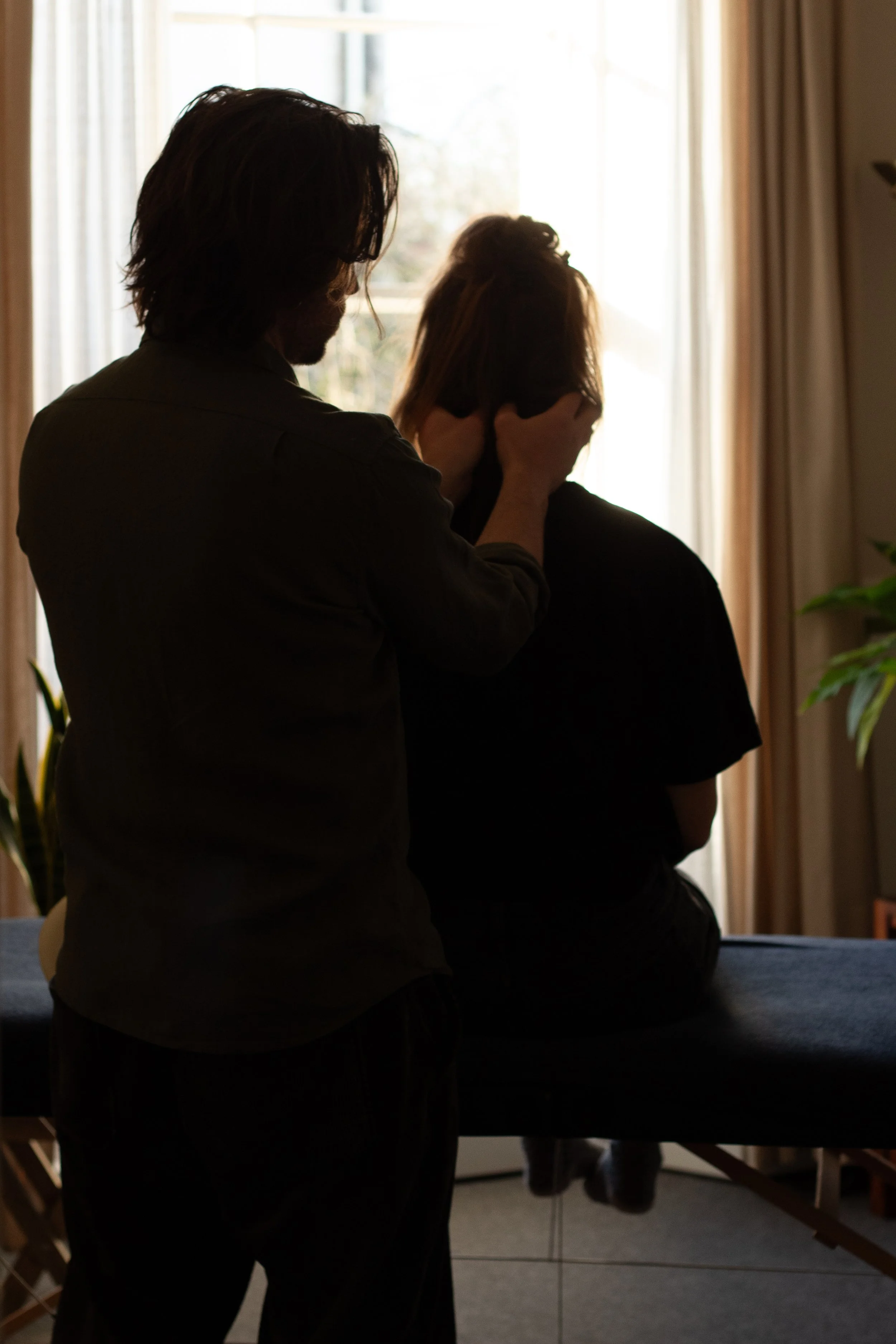
Sessions last 60 minutes. You remain fully clothed throughout - please wear something comfortable. We’ll begin with a conversation about anything relevant from your form or that’s come up for you recently. From there, I move into the hands-on work: a gentle, unhurried process of listening to your body, following what it needs, and working at a level that feels safe and comfortable for you. You’ll usually be lying on a treatment table, though I adapt to whatever works best for you.
-
Honestly, it depends - and anyone who tells you otherwise isn’t giving you a straight answer.
For general wellbeing, stress relief, or maintenance, many clients find a session every few weeks or monthly, feels about right. But if you’re coming with something more specific — an injury, a health condition, or emotional or physical trauma — a helpful rule of thumb in craniosacral therapy is to allow roughly one month of treatment for every year you’ve been carrying it.
That might sound like a long road, but in practice it rarely feels that way. The work is cumulative, each session builds on the last, and most people notice a shift well before the end of a course.
I’ll always give you my honest assessment after our first session, and we’ll map out a plan that makes sense for you, not a generic protocol.
-
More than you can imagine.
Craniosacral therapy works with the whole person - body, nervous system, and emotional landscape - rather than targeting a single symptom in isolation. This makes it particularly well suited to conditions that haven’t responded well to more conventional approaches, or where the root cause runs deeper than the presenting complaint.
People come to me with a wide range of conditions, including:
Chronic pain and back pain
Migraines and headaches
Stress, anxiety and burnout
Sports injuries
Sleep problems
Trauma (emotional or physical)
Grief and bereavement
Fertility challenges
Injuries (recent or long-held)
Postnatal and perinatal support for mothers and babies
This is by no means an exhaustive list. If you’re living with something that isn’t here, it’s still worth getting in touch. The question I’m really asking in every session is not “what is wrong?” but “what does this body need in order to find its way back to health?”
If you’re unsure whether craniosacral therapy is right for your situation, I’m always happy to have a conversation before you book.
-
Yes. Not only is it safe - in my experience, younger bodies often respond to it most quickly and most profoundly.
Craniosacral therapy is deeply gentle. There is no manipulation, no adjustment, no force. This makes it uniquely well suited to babies, children and teenagers, whose nervous systems are still developing and who can be particularly sensitive to more clinical or invasive approaches.
I treat clients of all ages, from newborns to teenagers, and the work adapts entirely to the size, age and needs of the person on the table.
My own relationship with craniosacral therapy began when I was 14. I was fighting regularly, being suspended from school, head butting people and walls, and battling chronic fatigue syndrome. I was, in short, a child whose body and nervous system were completely overwhelmed. It was at the Harley Street Children’s Cranial Osteopathy Centre that I first experienced this work - sometimes with up to three therapists working on me simultaneously.
What they found was a compression in my skull that had been there for ten years. When I was four years old I had fallen from a great height onto a radiator. That impact had never fully resolved. The compression it left behind was disrupting the equilibrium of my entire system, creating tension through my jaw that my body had been silently bracing against ever since.
When they released it, something shifted that I had no words for at the time. The impulse to lash out - to head butt, to fight - simply wasn’t there anymore. The chronic fatigue began to lift. Craniosacral therapy has been my go-to modality ever since, and it is a significant part of why I trained to practise it myself.
The other story is my daughter’s. Although she was born at home without intervention - birth in itself is an epic journey from one dimension to another - and her digestive system took time to acclimatise to life outside the womb. We visited our craniosacral therapist in those early weeks to help her, and us as a family, process these profound changes - and to help settle the colic that was causing her such unease.
I work with babies and families navigating all of these early challenges. That said, I believe deeply in knowing the limits of my own skills and experience. When it comes to lactation and latch specifically, I would not profess to be the right fit. In those cases, I can point you in the direction of an experienced professional. What matters is that you and your baby get exactly what you need.
These are not unusual stories. They are simply the ones closest to me.
If you’re wondering whether craniosacral therapy might help your child - at any age, including before they’ve even arrived - I’m always happy to have a conversation.
-
Yes - and for many women it becomes one of the most valuable forms of support they find during pregnancy.
Craniosacral therapy is completely safe throughout all stages of pregnancy. There is no pressure, no manipulation, no force. You remain fully clothed. The work is unhurried and deeply respectful of where you and your body are at any given moment.
Pregnancy places extraordinary demands on the body (postural changes, hormonal shifts, the profound physical and emotional weight of growing another human being). Craniosacral therapy offers a space to process all of that; to release tension, restore balance, and support your nervous system at a time when it is working harder than ever.
It can also work directly with your baby. Late in my wife’s pregnancy, our midwives told us that our daughter was in the wrong position, news that put our planned home birth in jeopardy. We visited our craniosacral therapist, and through gentle, focused work she was able to help turn our daughter and prepare her for a healthy, intervention-free birth at home. It was one of the most extraordinary things I have ever witnessed, and it played a profound part in my decision to train.
Whether you are in your first trimester or your final weeks, craniosacral therapy can offer meaningful support for your body, your nervous system, and your baby.
If you’d like to talk through whether it’s right for you at this stage of your pregnancy, please get in touch.
-
This is one of the most common questions I get, and one of the hardest to answer, because the experience is genuinely different for everyone.
Some people fall asleep on the table. Others describe a feeling of floating, of being only loosely tethered to their body. Some notice waves of energy moving through them, or unexpected sensations in parts of the body nowhere near where my hands are working (a warmth, a tingling, a sudden release of tension they didn’t know they were holding). Some people see colours, which often relate to the chakra points being given attention. You may also perspire, or feel heat radiating from my hands.
And some people, myself included, don’t feel very much at all during the session itself.
I say that not to manage expectations downward, but because I think it’s important to be honest. I have been receiving craniosacral therapy for most of my life, and there are sessions where I notice very little on the table. What I do notice, consistently and without exception, is that I always leave feeling better. That experiential evidence, felt not during the treatment but in the hours and days that follow, is what keeps bringing me back.
Craniosacral therapy works at a level that is often below conscious awareness. The shifts may be imperceptible to your usual tools of detection, but seismic in their impact on your body’s systems. You may not be able to point to what changed. You may simply notice, quietly, that something has.
-
The formal clinical research on craniosacral therapy is growing, but remains limited by the standards of conventional medicine. Double-blind trials are notoriously difficult to design for hands-on therapies, and large-scale funding tends to follow pharmaceutical interests rather than bodywork. This does not mean the evidence isn’t there. It means it hasn’t yet been gathered in the volume that satisfies the most sceptical scientific gatekeepers.
What does exist is a substantial and growing body of research supporting the underlying principles. The craniosacral rhythm - the subtle movement of cerebrospinal fluid around the brain and spinal cord - is well documented in neuroscience. The relationship between the nervous system and physical and emotional health is one of the most active areas of research in modern medicine. The work of Dr Bessel van der Kolk, particularly his landmark book on trauma and the body, has brought mainstream attention to exactly the terrain that craniosacral therapy has always worked in.
And then there is the evidence that no trial can capture: the lived experience of the people on the table. I have witnessed changes in my clients that I cannot fully explain, and experienced changes in myself that I cannot argue with. That is not science. But it is not nothing either.
I will never ask you to abandon your scepticism. I will simply ask you to stay curious.
-
It’s a fair question, and on the surface the two can look similar; you are lying down, and someone’s hands are on your body. But the similarities end there.
Massage works primarily with the muscular system. It uses pressure, friction and movement to release tension held in the muscles and soft tissue. It feels good. It can bring real relief. But it is working at the level of symptom rather than cause, and the effects, wonderful as they are, tend to be temporary.
Craniosacral therapy works at a far deeper and more subtle level. Rather than applying pressure to the body, I am listening to it, feeling for the craniosacral rhythm, tracking the movement of cerebrospinal fluid, and noticing where the body’s systems are blocked, compressed or out of balance. The touch is light. But what it is communicating with runs very deep.
The other significant difference is intention. A massage therapist works on your body. A craniosacral therapist works with it, following what the body itself is asking for, rather than imposing a technique from the outside.
Think of it this way. Massage is a conversation with the muscles. Craniosacral therapy is a conversation with everything beneath them.
Both have their place. But if you are dealing with something that has not shifted; chronic pain, trauma, exhaustion, stress that lives in your bones… craniosacral therapy is asking a different question altogether.
-
Not very much.
Wear something comfortable and loose - something you can lie down in easily.
Once you have made a booking I will send you a detailed client form covering your physical and emotional history. Please take your time with it. There are no wrong answers, and nothing is too small or too old to be relevant. A fall from a bicycle at seven, a bereavement you thought you had processed, a period of your life that left its mark: all of it is useful. All of it is welcome.
Beyond that, the most valuable thing you can bring is an open mind. You do not need to believe in craniosacral therapy for it to work. You do not need to know what you are looking for, or be able to articulate what feels wrong. Many of the most profound sessions begin with someone saying they are not sure why they came.
Your body knows. We will start there.